
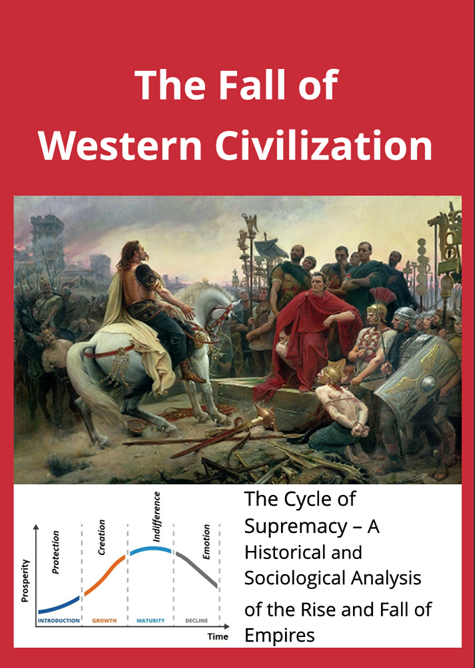
An interdisciplinary study of eight major empires and the structural forces shaping the rise, development and decline of civilizations.
For more than two thousand years, historians have described the rise and decline of great civilizations. But are these developments unique to each civilization, or can recurring structural forces be identified across very different historical societies?
The Fall of Western Civilization compares eight major empires and integrates historical evidence with sociology, economics, demography and institutional analysis to develop a general theory of civilizational development.
Rather than treating empires as isolated historical narratives, the book places them side by side to distinguish recurring mechanisms from events that are unique to particular societies.
Historical cases are examined comparatively across more than two millennia.
Protection, Achievement, Indifference and Emotion describe the long-term phases of civilizational development.
Population dynamics, institutions, prosperity and economic development are treated as measurable forces.
The historical framework is ultimately applied to contemporary Western civilization.
Discover the ideas, principles and historical mechanisms behind the rise and fall of civilizations.
The book proposes four recurring phases: Protection, Achievement, Indifference and Emotion. They describe changes in the values, institutions and behaviour of societies as prosperity and stability develop over time.
The civilization first requires security and stability. Hierarchy, tradition, customs, social cohesion and control help protect the society and make its resources usable.
With protection established, the focus shifts to creating value. Openness, innovation, debate, facts, discovery, rationality and flexibility support creation and progress.
As wealth creation becomes increasingly established and automated, the original urgency of creation weakens. Old traditions lose authority and purpose becomes less clearly defined.
As prosperity becomes highly automated, attention shifts increasingly toward the optimization of feelings, comfort and personal fulfilment rather than achievement and established value systems.
The phases are not presented as a mechanical timetable. The book describes transitions as gradual, often taking generations, with elements of different phases able to coexist.
The theory is developed through comparative analysis of seven historical empires, with the Roman Empire treated as a special eighth case.
The book ultimately asks how the four-phase framework applies to contemporary Western civilization. It considers demographic, economic, institutional and cultural developments against the longer historical pattern developed from the comparative cases.
The book begins with the problem of explaining civilizational rise and decline, develops a comparative framework through seven historical empires plus the Roman Empire, and then formulates and applies the four-phase theory.

Ulrik Vachet Rasmussen is the author of The Fall of Western Civilization, an interdisciplinary study combining historical comparison with sociology, economics, demography and institutional analysis.
The book develops a general theory of civilizational development and tests its explanatory value against major historical empires before applying it to the contemporary West.
Explore the historical evidence, comparative analysis and four-phase theory developed in The Fall of Western Civilization.