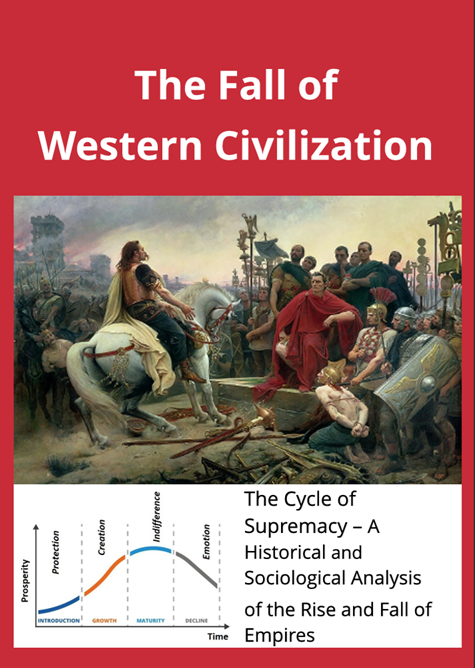
The Fall of Western Civilization builds on Ibn Khaldun, Oswald Spengler and Arnold Toynbee, integrating their contributions into a consistent framework for understanding how civilizations develop — and why their cultures can ultimately change.
The Fall of Western Civilization builds on the work of Ibn Khaldun, Oswald Spengler and Arnold Toynbee, integrating their contributions into a consistent framework for understanding the rise and decline of civilizations.
Khaldun identified culture as a driver of the rise and decline of civilizations, particularly through the strength or weakening of social cohesion and shared values. Spengler identified the morphology of civilizations — the recognizable developmental phases through which cultures emerge, mature and decline. Toynbee explained the development of civilizations through challenge and response, showing how creative responses to adversity can generate growth and strength.
The four-phase theory brings these insights together and asks a further question:
The theory approaches culture not simply as an observable characteristic of a society, but through its sociological and psychological mechanics: the ways in which values are formed, transmitted, reinforced and internalized by individuals, and how individual beliefs, behaviours and actions aggregate into the culture of a society.
The answer is sought in the changing relationship between values, human behaviour, prosperity and wealth creation.
A civilization initially faces external and internal challenges. These challenges create the need for protection and adaptation. Repeated successful responses gradually hone the culture toward the values, behaviours and forms of organisation that enable the civilization to survive and create wealth.
This produces the first stages of the developmental process:
But success changes the environment in which the culture operates.
As prosperity increases and wealth creation becomes increasingly established, organised and eventually automated, the challenges that originally shaped the culture become less important. The values that were necessary for creation consequently become less necessary.
The cultural response to adversity is gradually replaced by a cultural response to prosperity.
This produces the later phases:
The theory therefore proposes a mechanism connecting the observations of the three earlier thinkers. Toynbee helps explain the role of challenge and response in the formation of the culture; Khaldun identifies culture as a fundamental driver of the trajectory of civilizations; and Spengler identifies the recurring morphology of their development.
The four-phase theory attempts to explain the mechanism connecting these elements: how the conditions that create a civilization's culture can ultimately produce the conditions that transform that culture.
In this view, the decline of a civilization is not simply the result of external defeat or a failure to respond to a new challenge. It can arise from the transformation of the culture itself as prosperity changes the environment in which that culture operates.
The central proposition is therefore that the same process that creates the culture of achievement can, through increasing prosperity, eventually create the conditions for that culture to change.
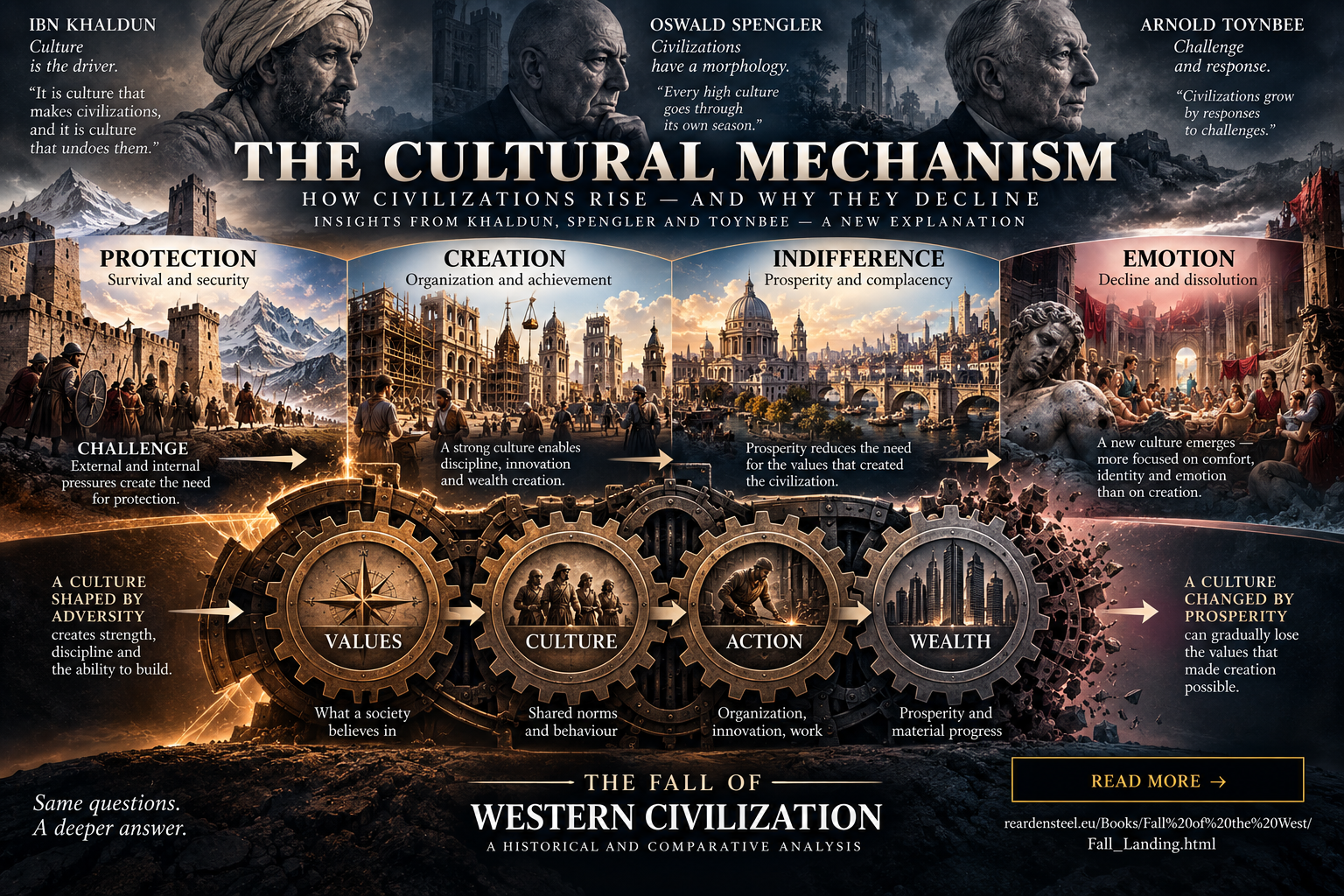
The book approaches culture not simply as an observable characteristic of a society, but as a system of values, beliefs, norms and behaviours that is formed, transmitted, reinforced and internalized by individuals — and aggregated into the culture of a society.
The central proposition is that values are fundamental drivers of culture, and that culture influences the formation, success and failure of civilizations.
Three major thinkers approached civilizational development from different directions. The four-phase theory brings these observations together and asks what mechanism connects them.
Khaldun identified social cohesion and shared values as important sources of strength. The book builds on this insight by asking how the underlying values of a civilization change.
Spengler described civilizations through a morphology of recurring developmental stages. The book asks what cultural mechanism might produce such changes.
Toynbee explained civilizational growth through the relationship between challenge and creative response. The book uses this to explain the formation of the early culture of a civilization.
A civilization initially faces external and internal challenges. These challenges create the need for protection and adaptation. Repeated successful responses gradually hone the culture toward the values, behaviours and forms of organisation that enable the civilization to survive and create wealth.
The four-phase theory describes a change in the culture surrounding wealth creation as the conditions of the civilization change.
External and internal challenges create the need for stability, security and adaptation. Protection creates the conditions for development.
The culture becomes oriented toward creation, innovation, cooperation, organisation and the productive use of resources.
As prosperity becomes established, the original drive for creation becomes less necessary. Older values can lose their force.
Prosperity can become sufficiently established that the values driving creation are pushed further out of the centre of the culture.
The answer is sought in the changing relationship between values, human behaviour, prosperity and wealth creation.
In the early development of a civilization, external and internal challenges create pressure for effective responses. Successful responses reinforce the values and forms of organisation that make those responses possible.
Over time, these values become embedded in the culture of the civilization.
Success changes the conditions under which the culture operates. As wealth creation becomes increasingly established, organised and eventually automated, the challenges that originally shaped the culture become less important.
The values that were necessary for creation consequently become less necessary.
The theory is developed and tested through comparative historical analysis of eight major empires. The cases span different regions, cultures and periods.
The framework is ultimately applied to Western Civilization. The book examines the West as a historical civilization and considers how its culture, institutions, demography, prosperity and wealth-creation mechanisms relate to the four-phase model.
The purpose is not simply to ask whether the West is wealthy or powerful, but whether the cultural mechanisms that created its prosperity remain aligned with the conditions under which that prosperity was originally generated.
Toynbee helps explain the role of challenge and response in the formation of a civilization's culture.
Khaldun identifies culture and social cohesion as fundamental drivers of the trajectory of civilizations.
Spengler identifies the recognizable morphology and developmental phases of civilizations.
The four-phase theory attempts to explain the mechanism connecting these elements: how the conditions that create a civilization's culture can ultimately produce the conditions that transform that culture.
In this view, decline is not simply the result of external defeat or a failure to respond to a new challenge. It can arise from the transformation of the culture itself as prosperity changes the environment in which that culture operates.
Explore the historical evidence, comparative analysis and four-phase theory developed in The Fall of Western Civilization.